
When life gets heavy, I go out dancing. It has always been my way out.
This time I was in Toronto. Social dancing does exist here, but it is strange in a way that means you should not be surprised to spend three hours at a social without dancing a single song. Too many leaders for every follower, tight circles that have known each other for years, and a newcomer at the edge of the room waiting for an opening that never comes. I wrote about all of it in The Hardest City I Have Ever Danced In.
So when the stress really hit, I sat down and did the maths. The only way out I could find was to go dancing. But I knew that taking a bus across Toronto would only end in another night at the wall. I wanted the place people describe as salsa everywhere, Latin rhythm on every corner.
That is how I ended up in Cartagena, a decision I came to regret deeply. If social dancing is bad in Toronto, in Cartagena it does not exist.
Do not misunderstand me. Colombia has a huge place in my heart. During COVID, when everywhere else was closed, Colombia was open, and I spent the best time of my life there. I went to Cartagena, to Medellín, to Bogotá, and I met amazing friends.
I had visited Cartagena twice before, and both times something bad happened. The last time, in 2024, I lost one of my best friends.
Before I go into the details, I want to tell you how much I love Cartagena. In my book there are two cities where I would love to live: Venice, Italy, and Cartagena, Colombia. I love the idea of a small, self-contained city you can cross from one end to the other on foot. I mean the walled city in Cartagena, of course, not the whole city, which I know is huge. And in Venice I mean only the part in the sea, not the city that stretches inland.
But the kind of social dancing where you walk in alone and leave having danced with ten strangers is either not there or extremely hard to find, and almost impossible to find in the one week I had.
The city is as beautiful as everyone says
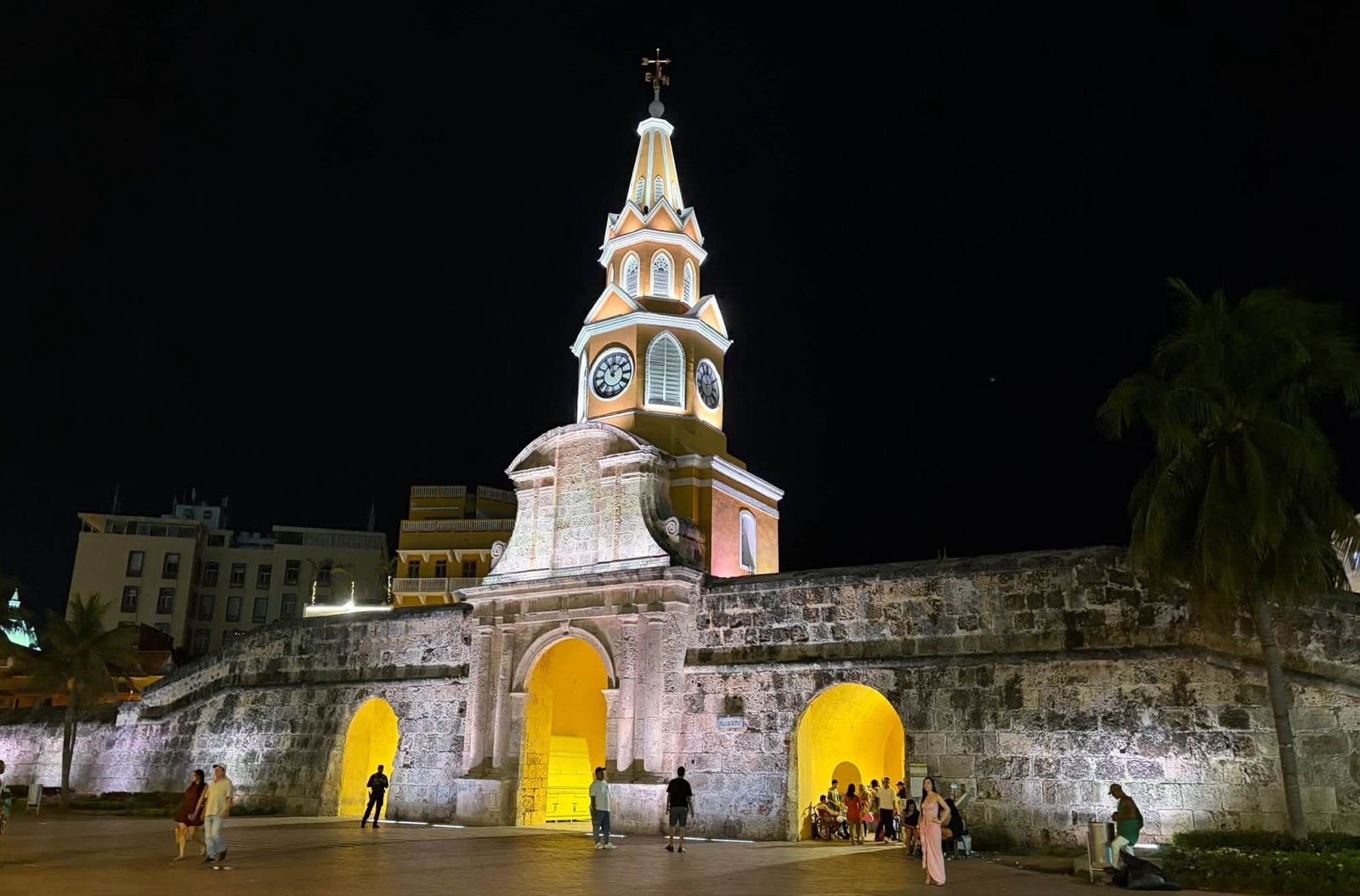
The Clock Tower, the gate into the walled city.
One of Cartagena's great attractions, and please pardon me for saying it, is that you walk into a city hundreds of years old and find everything modern inside it, including very good-looking women. Picture a stylish tourist from Europe, or from anywhere in the world, in beautiful clothes, walking through the middle of this very old city. Then picture the nightlife: women in heels walking down the walled streets. I do not care who they are or what they are doing there. I am not there to judge anyone. I am describing the whole picture, and the whole picture is exactly what makes Cartagena so attractive.
You walk past beautiful old houses. Then you step through one of those ancient doors and find a skylight in the middle, a pool, a big open space to sit in. I do not know why it gets me every time. Maybe it is the surprise. You do not expect the city to be that luxurious, and it is.
I love buying a small drink from a street vendor who squeezes the lemon or the orange in front of you. I love buying an empanada or an arepa, even though I usually take one bite and throw the rest away because the taste is too strong for me. It is still part of the whole experience.
Unfortunately, none of that is what I came for. That is what a regular tourist goes to Cartagena for: souvenirs, traditional Colombian clothes, Colombian dishes. That is not me. People travel for many reasons. I travel for one: dancing.
Where I looked
I tried the places I had access to, the places where I felt comfortable walking around without looking over my shoulder.
That does not mean Colombia is unsafe. It absolutely is not. In my experience it is a very safe country. I have spent more than two years there in total, nothing ever happened to me, and I felt safer there than I do in North America.
Here is what I found.
Social dancing
By social dancing I mean a place where locals and regular dancers come to meet others and dance freely. A woman can walk up and ask you to dance, or you can ask her. There is absolutely nothing sexual in your head or in hers, and at the end of the song you might kiss her hand and thank her for the dance.
That does not exist in Cartagena. Not at all. Not once in a whole week.
I tried everywhere. I went to the map and located places in the walled city, in Getsemaní, and even farther out. I never found a single social dance. The places that announced one, a social dance this Thursday, were completely empty when I arrived. When I asked the man at the door, he said: "Nobody came."
The famous salsa bars
Search the map for salsa and you will find well-known places inside the walled city. They are very small, and you need to bring someone to dance with: your wife, your girlfriend, a date. And even then there is no dance floor. You are dancing between chairs, and that is not dancing.
The bottle clubs
Then there are the places where you sit down, buy overpriced bottles, and find yourself surrounded by working girls. If any of them dances with you, it is because you are buying, because you have become part of the escort economy the city is suffering from.
I am not here to judge anybody. I am telling you that this is not a place for a dancer. Maybe it is a place for passport bros. Maybe it is a place for a dancer who wants to take his wife out salsa dancing in a charming city.
But for a single man travelling to dance and immerse himself in the social scene, it did not exist.
What was true of the walled city was true of Getsemaní, and of everywhere else I went.
The dancing bus
The closest I came to people simply having fun and dancing, not social dancing, not partner dancing, just people who wanted music and movement, was the party bus that drives around the city for an hour. It was nice. But again, you bring your family or your partner, you dance a little, and that is it. You never end up in the kind of social situation where you experience social dancing the way you do in Thailand, or the way it happens spontaneously in a city like Vancouver.
Why I was happy to go home
I had a second reason for the trip. I wanted to record videos, and even hire dancers from Cartagena's social scene, to launch my app, Dance Sage. It failed. Completely. So completely that when the time came to pack my bags, I was happy to go.
Because in the worst case in Toronto, you stand at the wall and watch people dance. You judge a little: that one is good, that one is not, I wish I could dance with her, she looks like a good dancer. In Cartagena even that does not exist. You sit in a bar, they expect you to buy drinks, they expect you to stay seated. If you want to dance, you dance alone.
And if you try to talk to people in the bar, most of them are tourists who are suspicious of other foreigners, or locals, and with locals you can sometimes end up in trouble, or simply end up dealing with working girls. Neither is a good situation for someone who wants to dance.
And that is what hurts, because this is a city where salsa, bachata, reggaeton and merengue follow you to breakfast, to lunch and to dinner. Everywhere, all the time. In Toronto or Vancouver you hear the music in a room where ninety per cent of the people do not speak Spanish. In Cartagena the workers, the people cleaning the street, sing along when a song comes on. That is the beauty of Cartagena.
But its dance scene does not include social dancing. At least not in the places where I felt safe to explore, the places I could walk through at one in the morning without feeling I was somewhere I should not be.
A beautiful city is not a dancer's city
Cartagena is still one of the two cities where I would love to live. I love its walls, its doors, its people, and the music that follows you everywhere.
But a beautiful city and a dancer's city are not the same thing. If you travel to dance, love Cartagena for everything it is, and go somewhere else to dance.